
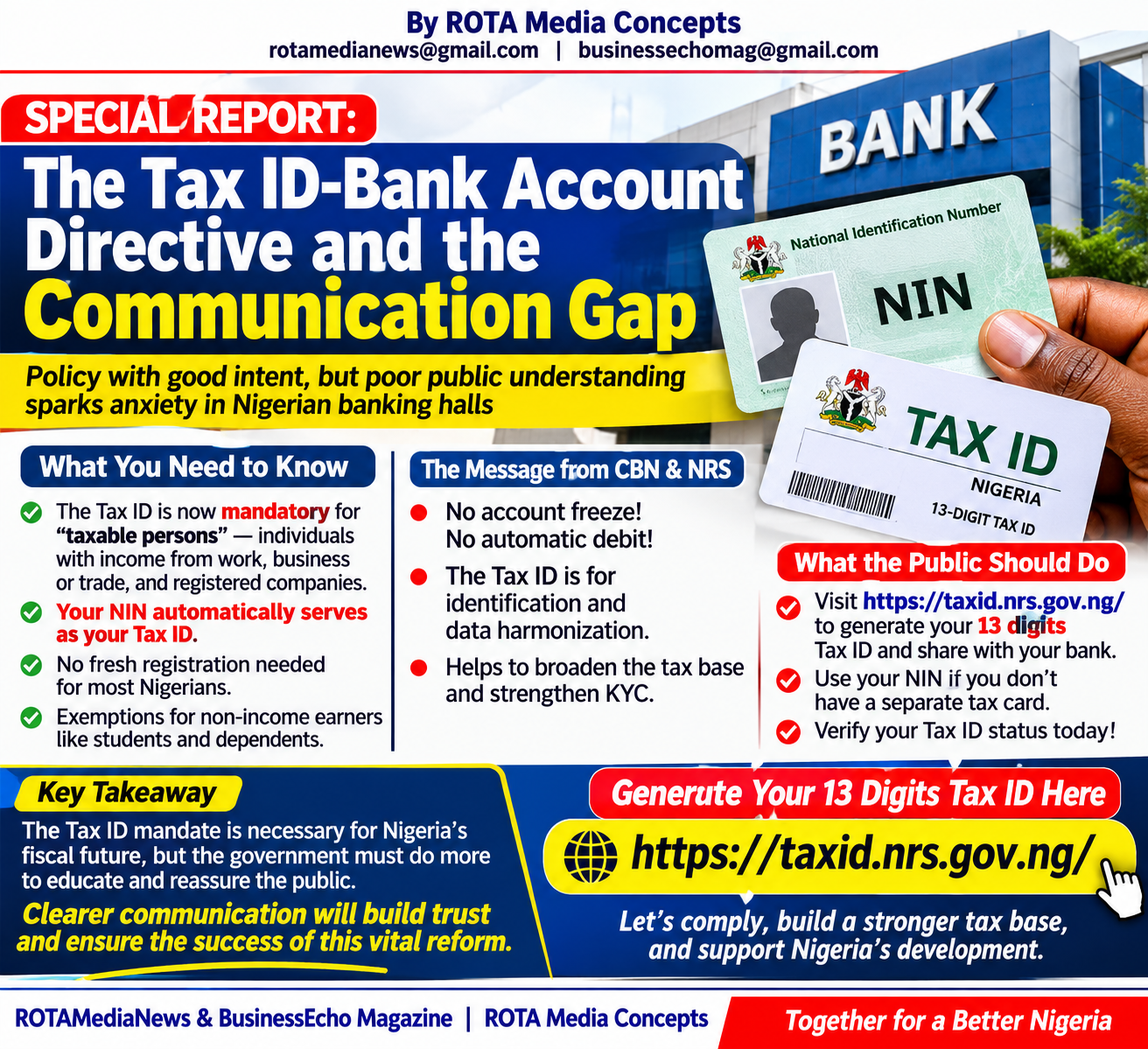

The Tax ID-Bank Account Directive And The Communication Gap
Written By Rashidat Okunlade, Lagos
A policy with roots stretching back to the Finance Act of 2020 has, in early 2026, become the single greatest source of anxiety in Nigerian banking halls. The directive requiring Tax Identification Numbers (now rebranded as “Tax IDs”) for bank account operation has been formally implemented under the Nigeria Tax Administration Act (NTAA) 2025, effective January 1, 2026 .
Yet, months into its rollout, a critical disconnect persists: the regulatory machinery has moved faster than public understanding, leaving millions of Nigerians uncertain whether their personal savings are at risk.
The Mandate: What the Law Actually Says
The directive is neither a blanket freeze nor an automatic debit scheme. According to the Nigeria Revenue Service (NRS) and the Joint Revenue Board (JRB), the Tax ID is mandatory for “taxable persons” individuals earning income through trade, business, or employment, and registered companies.
Under the new harmonized system, an individual’s National Identification Number (NIN) automatically serves as their Tax ID, while businesses utilize their Corporate Affairs Commission (CAC) registration number. Tax authorities insist most Nigerians need not undertake fresh registration; the identifier is generated from existing records.
Exemptions exist for non-income earners, including students and dependents . However, for the informal sector the trader with a POS terminal, the artisan with a savings account the distinction between “personal” and “business” banking is often nonexistent.
The Banking Sector Response
All commercial and digital banks operating in Nigeria including Access Bank, Zenith Bank, GTBank, First Bank, UBA, Fidelity Bank, Stanbic IBTC, Ecobank, Polaris Bank, Wema Bank, Sterling Bank, Union Bank, FCMB, Keystone Bank, Unity Bank, Providus Bank, and the digital-first platforms like Kuda, Opay, PalmPay, Moniepoint, and Carbon are technically bound by the CBN and NRS framework to request Tax IDs for account operations deemed taxable.
Fidelity Bank notably issued early customer notifications indicating that transaction restrictions would commence for accounts not linked to a TIN or NIN from January 1, 2026. Industry compliance officers describe a delicate balancing act: enforcing a legal mandate without triggering panic withdrawals or alienating low-income customers who form the backbone of digital banking adoption.
The Communication Failure: Announcements vs. Understanding
The central “unforeseen circumstance” of this policy is not the law itself, but the public communication strategy. Critics argue that the Federal Government and revenue agencies announced the enforcement deadline with insufficient grassroots sensitization.
Taiwo Oyedele, Chairman of the Presidential Committee on Fiscal Policy and Tax Reforms, has repeatedly attempted to douse flames of panic, clarifying that accounts will not be frozen nor automatically debited. He emphasized that the provision is for identification and data harmonization, primarily targeting business accounts.
However, the distinction between a “business account” and a “personal account used for business” remains legally grey. In a country where over 38 million adults were already financially excluded prior to this policy, the requirement of a Tax ID even if automatically generated has created a perception of a new bureaucratic hurdle.
State revenue agencies have reported surges of anxious residents, particularly the elderly, seeking clarification. The Ekiti State Internal Revenue Service publicly debunked rumors of account freezes, calling the panic a “fallacy” while acknowledging the influx of worried citizens into their offices.
Regulatory and Governmental Stance
The Federal Government, through the Ministry of Finance and the NRS, maintains that the reform is existential. With Nigeria’s tax-to-GDP ratio hovering below 10%, officials argue that linking financial activity to tax identity is the only way to broaden the net without crushing the already overburdened formal sector.
The Central Bank of Nigeria (CBN) supports the initiative as a strengthening of Know-Your-Customer (KYC) protocols and a tool against money laundering . Other regulatory bodies, including the Joint Revenue Board (JRB) and state Internal Revenue Services, are tasked with the actual registration and validation, though system integration challenges have forced some applicants to visit physical offices for biometric or document validation.
The ROTAMediaNews & BusinessEcho Take
The intent behind the Tax ID mandate is fiscally sound. Nigeria cannot sustain its budget deficits without expanding the tax base. However, the implementation timeline and communication strategy have been deeply flawed.
By allowing a narrative of “No TIN, No Account” to fester for months before clarifying that NINs automatically generate Tax IDs, the government created a crisis of confidence. In a digital economy where trust is the currency, the fear of arbitrary account restrictions is enough to push vulnerable citizens back toward cash hoarding, the exact opposite of the financial inclusion goals the CBN claims to pursue.
Effective Date Reality: While the law took effect January 1, 2026, enforcement by banks appears phased and inconsistent. Some institutions are prioritizing new account openings and high-value business transactions, while largely sparing dormant or low-balance personal accounts from immediate restrictions.
What the Public Should Do: The general public is advised to verify their Tax ID status via the Joint Tax Board portal using their NIN. For those without a NIN or CAC registration, that underlying documentation not a separate “tax card” is the prerequisite for full compliance.
Please visit https://taxid.nrs.gov.ng/ to generate your 13 digits Tax ID and share with your bank
Until the NRS and CBN launch a unified, vernacular-language mass education campaign that reaches beyond Twitter and newspaper op-eds, the gap between policy and public comprehension will remain the greatest risk to this reform’s success.
© ROTAMEDIANEWS Digital Newspaper & BusinessEcho Magazine by ROTA Media Concepts
For advert placement, news tips and subscription enquiries, contact the Publisher/Editor-in-Chief, Rashidat Olushola Okunlade.
rotamedianews@gmail.com businessechomag@gmail.com
08082881578-08060575197