


… NASENI to establish local irrigation equipment production plant as Nigeria targets 40,000 hectares in Adamawa
By Rashidat O. Okunlade | Lagos
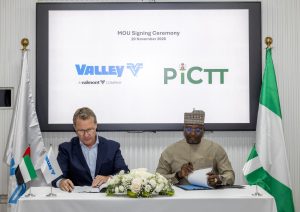
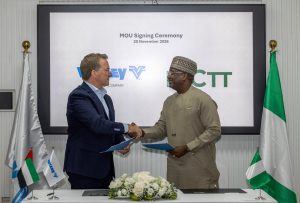
In a major step toward achieving food security and agricultural transformation, the Presidential Implementation Committee on Technology Transfer (PICTT) has formally signed a Memorandum of Understanding (MoU) with Valmont Industries, Inc., the world’s largest manufacturer of pivot irrigation systems.
The signing, which took place at the weekend, marks a significant milestone in the Federal Government’s flagship Irrigate Nigeria Programme.
According to the Chairman of PICTT, Dr. Dahiru Muhammed, who also coordinates the full implementation of the Irrigate Nigeria Programme, the MoU officially brings Valmont through its Valley Irrigation brand on board as a major partner in the development of irrigation infrastructure across the country.
Local Production and Technology Transfer
A critical component of the agreement is the commitment to domesticate the technology. Under the MoU, Valmont has agreed to partner with the National Agency for Science and Engineering Infrastructure (NASENI) to establish an irrigation equipment production plant in Nigeria.
The partnership comes with a firm commitment to transfer know-how and build the capacity of Nigerians, positioning the country to manufacture mechanized irrigation technology locally rather than relying solely on imports.
“This MOU officially brings the biggest pivot irrigation manufacturer in the world on board as a major partner in building irrigation infrastructure across Nigeria under the Irrigate Nigeria Programme,” Dr. Muhammed said.
“Valmont will not only partner with us in building irrigation infrastructure they have also agreed to partner with NASENI to build an irrigation equipment production plant in Nigeria. Just as importantly, this partnership comes with the transfer of know-how and capacity building for Nigerians, which is precisely what technology transfer is all about,” he added.
The agreement was signed by Dr. Muhammed and the Regional Vice President, Middle East and Africa, Valmont, Mr. Kalle Autto.
40,000-Hectare Pilot in Adamawa
The agreement sets the stage for a pilot programme covering 40,000 hectares in Adamawa State, to be implemented in collaboration with the Nigeria Incentive-Based Risk Sharing System for Agricultural Lending (NIRSAL) and the Agricultural Development Fund (NADF). PICTT will lead the full implementation, while NASENI will drive the adoption and domestication of the technology.
There are also promising opportunities to collaborate with the University of Nebraska and the Robert B. Daugherty Water for Food Global Institute on sustainable irrigation systems and water resource management.
Dr. Muhammed noted that key stakeholders had already shown interest in scaling irrigation infrastructure using the partnership, describing it as a strong vote of confidence in the direction of the programme.
Global Scale, Local Impact
Valley Irrigation’s global footprint underscores the scale of the partnership: more than 40 percent of center pivots in service worldwide are Valley machines, with over 250,000 Valley pivots operating across 120-plus countries and approximately 12 million hectares under irrigation.
Valmont Industries itself brings 80 years of industrial expertise, net sales of $4.1 billion in 2025, 83 manufacturing facilities, operations in over 100 countries, roughly 11,000 employees, and 31 distinct brands.
Officials noted that the partnership marks an important step toward enhancing agricultural productivity, strengthening national food security, and promoting the sustainable use of water resources in line with the administration’s agricultural transformation agenda.
What To Know About the Irrigate Nigeria Programme
The Irrigate Nigeria Programme is the Federal Government’s flagship irrigation initiative under the present administration, designed to expand irrigated agriculture, reduce post-harvest losses, boost year-round food production, and improve the livelihoods of farming communities across the country. The programme is coordinated by the PICTT under the chairmanship of Dr. Dahiru Muhammed.
What To Know About Valmont Industries, Inc.
Headquartered in Omaha, Nebraska, USA, Valmont Industries, Inc. is a leading, diversified industrial manufacturer and the world’s largest producer of pivot irrigation equipment. For more than 80 years, Valmont has delivered infrastructure that supports critical human needs including food, water, energy, and communications across more than 100 countries.
Why It Matters
Nigeria’s agricultural sector has long been hampered by its dependence on rain-fed farming. This leaves the country vulnerable to the vagaries of climate change and severely limits the potential for year-round food production.
This MoU with Valmont Industries represents a strategic shift from short-term interventions to long-term structural transformation. The decision to involve NASENI in establishing a local production plant is particularly crucial. Nigeria cannot achieve food security by importing irrigation equipment; it must develop the industrial capacity to manufacture these systems locally.
The 40,000-hectare pilot in Adamawa is a bold first step. If successful, it could serve as a blueprint for scaling irrigated agriculture across the country’s vast arable land. The involvement of NIRSAL and NADF ensures that the financing mechanisms are in place to support farmers in adopting this technology.
Furthermore, the partnership with the University of Nebraska and the Daugherty Water for Food Global Institute brings world-class research and water management expertise to the table. This is essential for ensuring that the expansion of irrigation does not lead to the depletion or degradation of Nigeria’s water resources.
As Nigeria continues to grapple with food inflation and the urgent need to feed its growing population, public-private partnerships like this offer a realistic pathway to sustainable agricultural development.
© ROTAMEDIANEWS Digital Newspaper & BusinessEcho Magazine by ROTA Media Concepts
For advert placement, news tips and subscription enquiries, contact the Publisher/Editor-in-Chief, Rashidat Olushola Okunlade.
rotamedianews@gmail.com businessechomag@gmail.com