
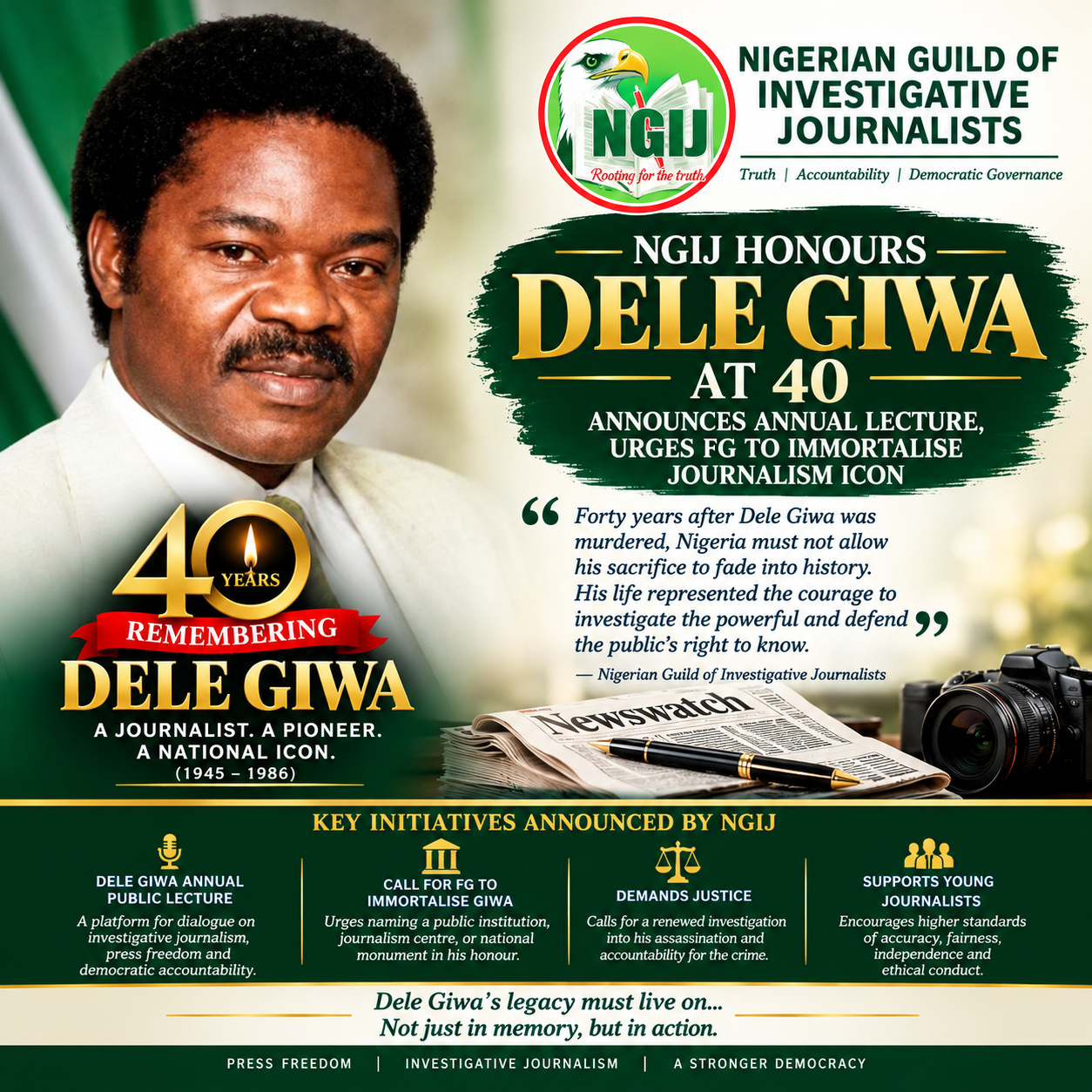

… Launches Annual Public Lecture to cement Giwa’s legacy, says four decades of impunity must end
By Rashidat O. Okunlade | Lagos

The Nigerian Guild of Investigative Journalists (NGIJ) has paid tribute to the late veteran journalist, Dele Giwa, on the 40th anniversary of his assassination, describing his death as a defining moment in Nigeria’s struggle for press freedom, accountability, and democratic governance.
Giwa, co-founder and pioneer Editor-in-Chief of Newswatch magazine, was killed by a parcel bomb delivered to his Lagos residence on October 19, 1986, during the military era. Forty years after the incident, his assassination remains unresolved, with no one held accountable for the murder.
In a statement issued by NGIJ President, Mallam Abdulrahman Aliagan, and the Guild’s Secretary, Rowland Olonishuwa, the Guild described Giwa as a symbol of journalistic courage whose commitment to fearless reporting helped shape investigative journalism in Nigeria.
‘A Painful Reminder’
The Guild emphasized that Giwa’s legacy transcends his professional achievements, embodying journalism’s responsibility to question authority, expose wrongdoing, and defend the public interest.
“Forty years after Dele Giwa was murdered, Nigeria must not allow his sacrifice to fade into history. His life represented the courage to investigate the powerful and defend the public’s right to know. His death remains a painful reminder of the price journalists can pay for pursuing the truth,” NGIJ stated.
The Dele Giwa Annual Public Lecture
As part of efforts to preserve Giwa’s legacy, NGIJ announced plans to establish the Dele Giwa Annual Public Lecture on Investigative Journalism, which will be the Guild’s maiden public lecture.
The initiative will provide a platform for journalists, media executives, policymakers, academics, and civil society organisations to discuss press freedom, investigative reporting, democratic accountability, and the safety of journalists.
“We do not want Dele Giwa to be remembered only through anniversary tributes. We want his name to become a permanent institution in advancing investigative journalism in Nigeria,” the Guild declared.
Call for Immortalisation
NGIJ called on the Federal Government to immortalise Giwa in recognition of his contributions to Nigerian journalism, democratic accountability, and the public’s right to information.
The Guild urged the government to consider naming a public institution, national journalism centre, media research facility, or another appropriate national monument after the late journalist.
It said such recognition would affirm the vital role of journalists in nation-building and inspire younger generations to embrace courage, integrity, and service to the public interest.
“National recognition should extend beyond political leaders and public officeholders to include professionals whose sacrifices have significantly advanced democratic development and the protection of citizens’ rights,” NGIJ added.
Justice Cannot Be Extinguished by Time
While celebrating Giwa’s contributions, the Guild expressed deep concern that the circumstances surrounding his assassination remain unresolved four decades later.
It called on the Federal Government, law enforcement agencies, and relevant judicial authorities to renew efforts to establish the circumstances of his death, review available evidence, and pursue credible investigative leads in accordance with the law.
“A nation cannot adequately honour a journalist who died in the pursuit of truth while allowing the questions surrounding his murder to remain unanswered. Remembrance must be accompanied by action, and tributes must translate into a renewed commitment to justice, accountability, and the protection of journalists,” the Guild said.
A Charge to the Next Generation
NGIJ urged Nigerian journalists, particularly young and aspiring investigative reporters, to draw inspiration from Giwa’s courage while upholding the highest standards of accuracy, fairness, verification, independence, and ethical conduct.
The Guild reaffirmed its commitment to promoting credible, independent, and impact-driven investigative journalism through professional training, institutional partnerships, public-interest investigations, and accountability initiatives.
It also called on media organisations, government institutions, civil society groups, development partners, and the public to support efforts to improve journalists’ safety, strengthen newsroom independence, and create an enabling environment for responsible reporting.
“Dele Giwa may have been silenced 40 years ago, but the ideals he represented must never be silenced. His legacy must live on in every journalist who dares to investigate, every report that exposes wrongdoing, every institution held accountable and every citizen empowered by the truth,” NGIJ concluded.
Why It Matters
The assassination of Dele Giwa remains a festering wound in the conscience of Nigerian journalism. On October 19, 1986, a parcel bomb allegedly sent by state agents, robbed the nation of one of its brightest investigative minds. The fact that, 40 years later, no one has been prosecuted for this heinous crime speaks volumes about the fragility of justice and the culture of impunity in Nigeria.
For NGIJ, the failure to solve Giwa’s murder is not just a historical footnote; it is a clear and present danger to every practicing journalist today. When the state fails to protect or avenge its truth-tellers, it sends a chilling message that those who wield power can silence dissent with absolute immunity.
The decision to launch the Dele Giwa Annual Public Lecture is a masterstroke in institutional memory. It ensures that Giwa’s name is not confined to the dusty shelves of history books but is actively invoked in the ongoing struggle for a free press. By tying his legacy to an annual intellectual forum, the Guild is ensuring that the torch of investigative journalism he carried continues to illuminate the darkest corners of governance.
The call for the Federal Government to immortalise him is both symbolic and necessary. Nigeria’s national monuments and institutions are often named after politicians and military rulers. Elevating a journalist to that pantheon would be a profound statement that the pen is indeed mightier than the sword, and that the pursuit of truth is a foundational pillar of the nation.
However, the most critical demand remains the pursuit of justice. As NGIJ rightly notes, “Remembrance must be accompanied by action.” Until the state reopens the Giwa file, follows the evidence, and brings his killers to book, if they are still alive the shadow of the parcel bomb will continue to hang over Nigeria’s democratic claims.
© ROTAMEDIANEWS Digital Newspaper and BusinessEcho Magazine by ROTA Media Concepts
For advert placement, news tips and subscription enquiries, contact the Publisher/Editor-in-Chief, Rashidat Olushola Okunlade.
rotamedianews@gmail.com businessechomag@gmail.com
08082881578-08060575197