

… As experts say nourishing food is the foundation of national health
Written By Rashidat O. Okunlade, Lagos

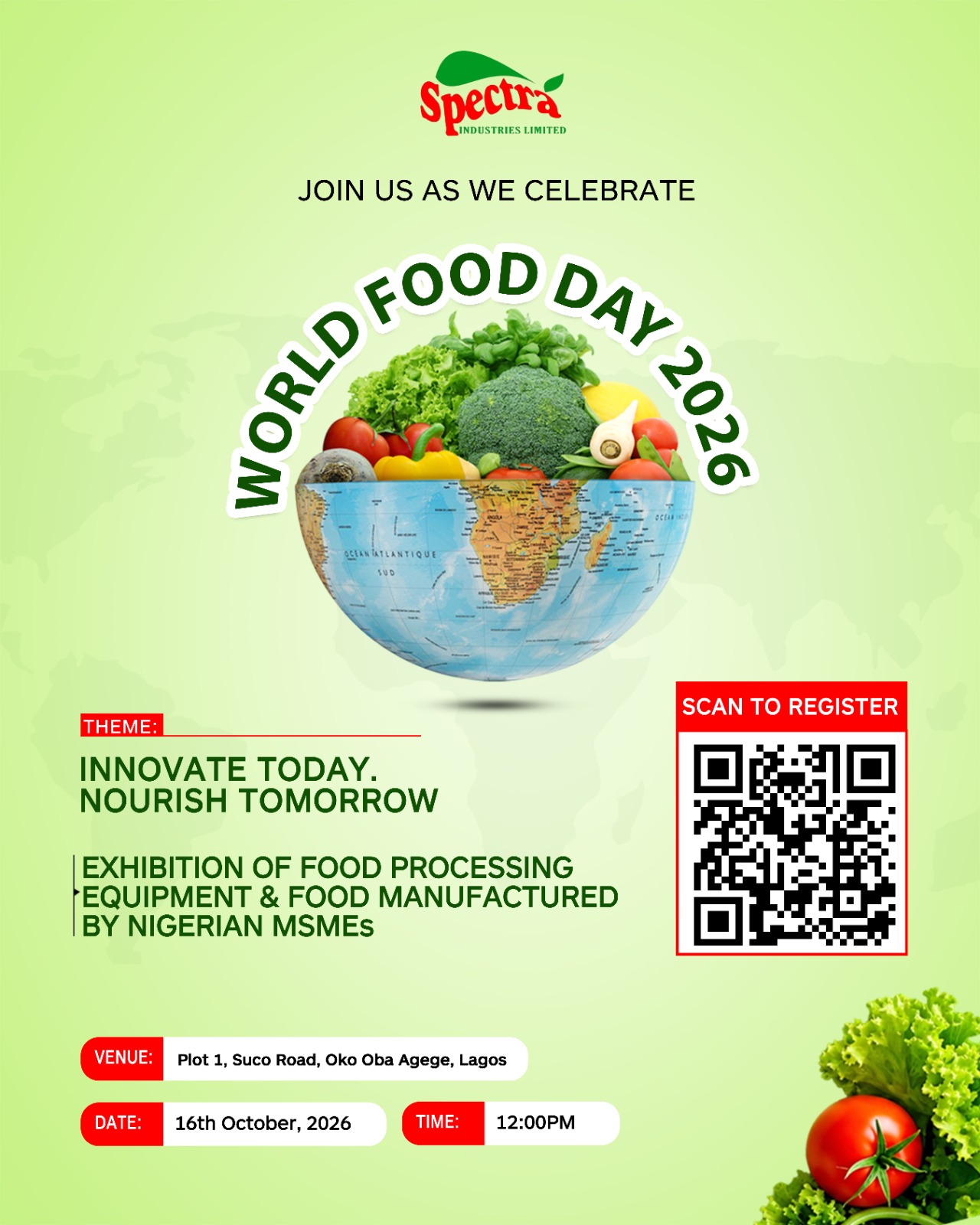
Spectra Industries Limited is set to host a landmark commemoration of World Food Day 2026, convening stakeholders across Nigeria’s food processing value chain for an exhibition showcasing food processing equipment and food products manufactured by Nigerian Micro, Small and Medium Enterprises (MSMEs).
The event is scheduled for Friday, October 16, 2026, at Plot 1, Suco Road, Oko-Oba Agege, Lagos, beginning at 12:00 noon.
The Importance of Good and Nourishing Food
World Food Day, observed annually on October 16, marks the founding of the Food and Agriculture Organization (FAO) of the United Nations in 1945. The day is dedicated to raising awareness of hunger, food security and the need for sustainable food systems concerns that remain acutely relevant to Nigeria.
The 2026 theme, “Innovate Today. Nourish Tomorrow,” is a call to action. According to the United Nations, food is a basic human right, yet around 645 million people faced hunger last year, and nearly 2.7 billion people cannot afford a healthy diet. The FAO emphasises that forward-thinking solutions, combined with traditional knowledge and inclusive approaches, can help ensure that everyone has access to sufficient, diverse, safe, and nutritious foods.
In Nigeria, the stakes are particularly high. The Federal Government has revealed that the country is grappling with a “triple burden” of malnutrition undernutrition, overnutrition, and micronutrient deficiencies known as hidden hunger. Findings from the National Food Consumption and Micronutrient Survey revealed that 79 per cent of Nigerians are food insecure, while micronutrient inadequacy among key population groups remains very high. According to the 2024 Nigeria Demographic and Health Survey, 40 per cent of children are stunted, 8 per cent wasted, and 27 per cent underweight.
Good nutrition is not merely a health issue; it is a foundation for national productivity, cognitive development, and economic potential. Micronutrient deficiencies impair cognitive development, reduce productivity, and increase maternal and child mortality. Nourishing food food that is safe, diverse, and rich in essential vitamins and minerals is therefore a prerequisite for Nigeria’s development, not an afterthought.
What Spectra Foods Has Been Contributing
Spectra Industries Limited has been a quiet but significant contributor to Nigeria’s nourishing food landscape for over three decades. Founded by food technologist Chief Duro Kuteyi, the company has built its reputation on a simple but powerful premise: good health begins with good food and good food should be within everyone’s reach.
The company’s operations are built around two core raw materials: cocoa and soya. From these, Spectra produces a range of products designed to meet everyday nutritional needs energising cocoa beverages rich in antioxidants and protein, alongside protein-rich soya-based meals and flours.
Among its flagship products are Sobake Defatted Flour, a soybean-based ingredient high in protein and lysine; Hyfiba, a sorghum-based product; Fast O Meal; and Suco Cocoa Powder. Spectra products are well blended with high dietary fibre, which helps boost consumers’ immunity, and they are rich in vitamins and minerals.
Kuteyi, a seasoned food technologist, has emphasised that his company’s commitment to processing and manufacturing is driven by the imperative for Nigerians to eat healthy to live a healthy life. During the COVID-19 lockdown, Spectra partnered with the Federal Government, processing 10 trailers of sorghum into Hyfiba for distribution to vulnerable groups across Abuja, Katsina, Niger, Ekiti, Lagos, Plateau, Bauchi, and other states.
The company has also demonstrated a commitment to food security beyond its commercial operations. Spectra Industries and the Nigerian Armed Forces Resettlement Centre (NAFRC) have collaborated to optimise Nigeria’s food value chain, including the production of Ready-to-Eat military rations and training for retiring servicemen in food processing techniques.
Regulatory Framework: NAFDAC and FCCPC on Good Food and Drinks
The production of safe and nourishing food in Nigeria is governed by a robust regulatory framework involving multiple agencies.
The National Agency for Food and Drug Administration and Control (NAFDAC) is the primary regulator for food safety and quality. In 2022, NAFDAC established legal limits for industrially produced trans fats, mandating that they not exceed 2 grams per 100 grams of total fat in all foods. Trans fats are strongly linked to heart disease, stroke, and premature death, with high intake increasing the risk of heart disease deaths by 28 per cent. NAFDAC has given food companies 18 months to eliminate industrially produced trans-fatty acids from their products.
NAFDAC has also introduced regulations to reduce sodium content in processed and pre-packaged foods, setting mandatory sodium limits for key food categories including bread, noodles, cheese, and snacks. The agency’s approach is science-driven, with the Director-General, Prof. Mojisola Adeyeye, stating: “The removal of industrially produced trans fats from the food chain is not only a technical achievement but also a moral imperative”.
The Federal Competition and Consumer Protection Commission (FCCPC) complements NAFDAC’s work by addressing market practices and consumer protection. The FCCPC has warned food vendors against harmful practices including the forceful ripening of fruits using calcium carbide (which contains toxic arsenic and phosphorus), and the adulteration of food with dangerous additives such as bromate, Sudan red colorant, and formalin.
Mr. Olatunji Bello, Executive Vice Chairman of the FCCPC, has stressed that food is a fundamental human right: “Access to safe, unadulterated, and nutritious food is a key pillar of public health, economic development, and national security.” He warned that any operator who prioritises profit over public safety will face the full weight of the law.
The Federal Ministry of Health and Social Welfare provides overarching policy direction through the revised National Policy on Food Safety and Quality, the National Guideline for Sodium Reduction, and the National Guideline for Food Handlers’ Medical Test. The Ministry has activated Technical Working Groups covering risk-based regulation, traceability, and food inspection to drive science-based food safety governance.
The Standards Organisation of Nigeria (SON) works in collaboration with NAFDAC and FCCPC on standards enforcement .
A Theme Rooted in Innovation and Sustainability
The 2026 commemoration is themed “Innovate Today. Nourish Tomorrow”, a framing that places technological innovation and sustainable food systems at the centre of Nigeria’s food security conversation.
At the heart of the event is an exhibition dedicated to food processing equipment and food products manufactured by Nigerian MSMEs. The focus on indigenous manufacturers is significant: Nigeria’s food processing sector remains heavily dependent on imported machinery, a dependency that exposes businesses to exchange rate volatility while limiting the growth of local fabrication capacity.
Registration and Participation
Interested participants, exhibitors and members of the public are invited to register for the event via the QR code provided on the official event flyer.
Event Details
Event: World Food Day 2026 Commemoration & Exhibition
Theme: Innovate Today. Nourish Tomorrow
Organiser: Spectra Industries Limited
Date: Friday, October 16, 2026
Time: 12:00 noon
Venue: Plot 1, Suco Road, Oko-Oba Agege, Lagos
Focus: Exhibition of food processing equipment and food manufactured by Nigerian MSMEs
Registration: Via official QR code
Why It Matters
World Food Day is not merely a calendar event. It is a reminder that food security is national security, and that nutrition is the foundation upon which health, productivity, and economic development rest.
Nigeria’s food system faces a paradox: the country produces enough food to feed itself in theory, yet 79 per cent of its people are food insecure . The gap lies not only in production but in processing, preservation, distribution, and affordability, precisely the areas that Spectra Industries and its MSME partners are working to address.
The regulatory framework is in place. NAFDAC has set limits on trans fats and sodium. The FCCPC is enforcing standards against adulteration. The Federal Ministry of Health has laid out a science-based roadmap. What remains is the alignment of industry, regulation, and consumer awareness, a collective responsibility that World Food Day invites Nigerians to embrace.
Innovate Today. Nourish Tomorrow. The theme is a challenge as much as a celebration. And for Nigeria, it is a challenge that cannot wait.
© ROTAMEDIANEWS Digital Newspaper & BusinessEcho Magazine by ROTA Media Concepts
For advert placement, news update, celebrity tips and subscription enquiries, contact the Publisher/Editor-in-Chief, Rashidat Olushola Okunlade.
rotamedianews@gmail.com businessechomag@gmail.com
08082881578-08060575197